



When a GE fridge stops cooling, diagnostic order matters. A stalled evaporator fan, a failed defrost heater, or condenser coils packed with dust account for most cases. Ice trouble usually means a frozen fill tube or a tired water inlet valve, and thawing that tube often confirms which one it is.
Top-load models with a Hydro Wave motor sometimes recover after a power reset and a lid cycle, so that gets tried before anything comes apart. A dead lid switch or a stretched drive belt stops the spin outright. Standing water almost always traces to a clogged drain pump or filter screen.
A dishwasher holding water usually has a blocked air gap, a kinked drain hose, or debris in the sump, and clearing that is often the entire repair. An oven that never reaches temperature points to a split bake element or a drifting sensor, both of which we can test in minutes on site.
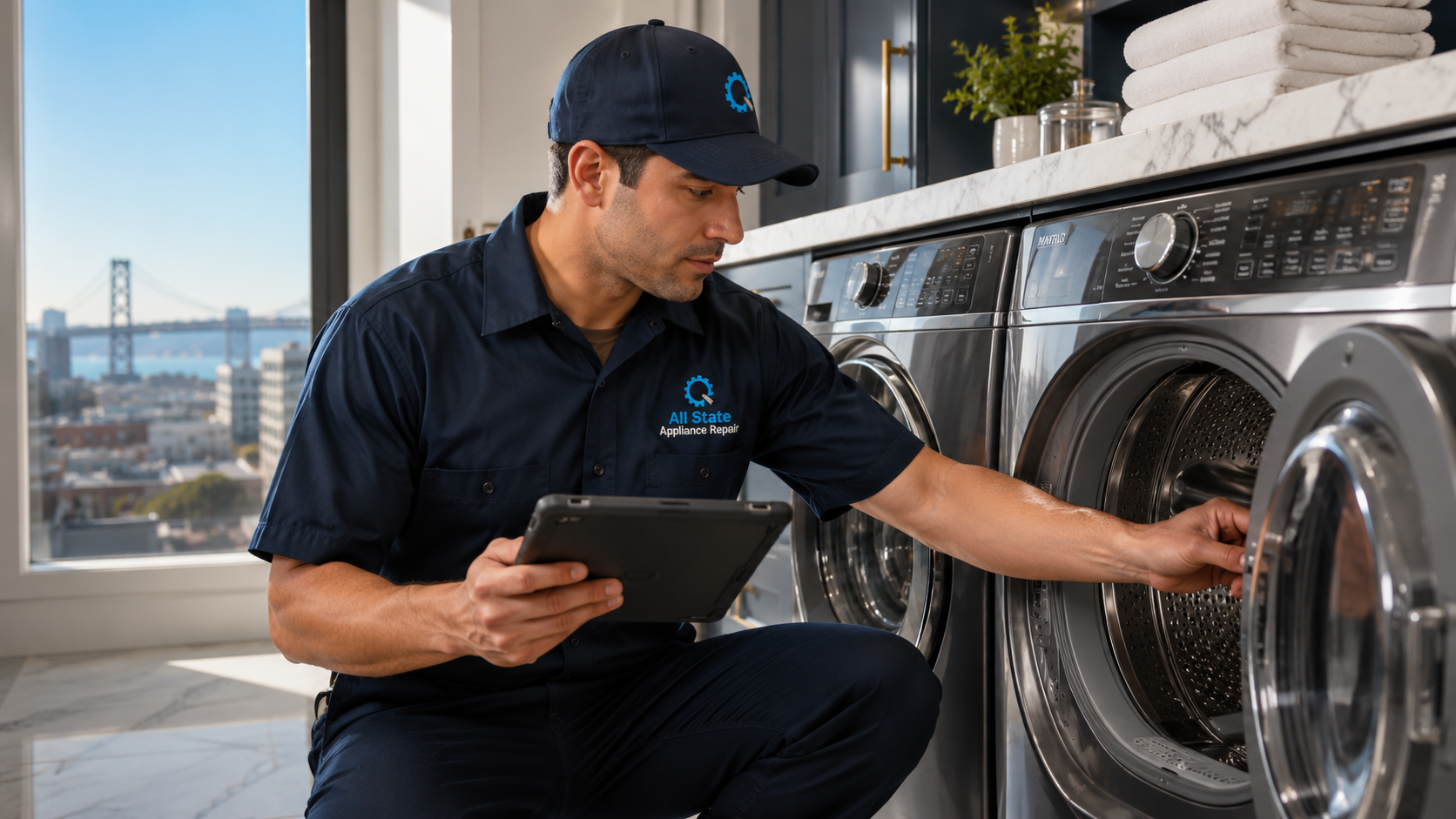
Washers arrive with four complaints. No spin, standing water, a leak, or a flashing code. We read stored faults first, then check the pump, door lock or lid switch, hoses, and bearing play before quoting, because a code by itself rarely names the failed part on these newer platforms.
Electric and gas dryers both land on our schedule, front-load tumble units and top-load pairs included. No heat usually means an element, thermal fuse, or igniter, while a machine that will not start points to a door switch or start relay. The vent run gets inspected on every visit.
Freestanding French door models, Cafe units set into cabinetry, and Monogram columns follow the same diagnostic order. Airflow, defrost, sensors, then the sealed system. Ice maker work covers filters, fill valves, and modules, and built-in service includes protecting the surrounding millwork.
A dishwasher that will not drain, clean, or start usually points to the pump, the spray arms and filter stack, or the door latch and control board. We check incoming water temperature and fill level too, since poor washing is often a fill shortfall rather than a mechanical failure.
Ranges, cooktops, and wall ovens come to us with burners that will not light, uneven baking, and control panels that stop responding. We test igniters, spark modules, bake and broil elements, thermistors, and touch boards, then calibrate the cavity against a probe before the panel goes back on.
Newer boards flash green consumer codes on the dispenser panel, usually with a beep. Some flag fan, defrost, or thermistor faults, while TurboCool and TurboFreeze indicators are normal operation mistaken for failure. We pull the whole set in diagnostic mode instead of reacting to one display.
Dishwashers report trouble as codes or blinking lights depending on the model year. H2O covers a fill shortfall, C4 an overfill, C6 and C7 water temperature and thermistor problems, C8 a blocked detergent cup, and PF a power interruption during a cycle. Each one points at a different circuit.
Front-load platforms store faults you reach by holding the start pause key for about ten seconds. E22 flags a fill timeout, E30 and E31 drain trouble, E42 and E45 motor or overload conditions, and E60 through E64 door lock failures. Read the stored history before replacing anything.
Range and oven controls report F codes. F1 and F2 cover an open or shorted oven thermistor, F3 a shorted touch pad, F6 a failed temperature probe, F9 or FC a door lock fault, and FD a bad meat probe. Newer control boards extend that logic into three-digit F1xx faults needing a service reference.
Electronic front-load dryers hold codes in a diagnostic mode entered from the console. Most point to thermistors, thermal cutoffs, moisture sensing bars, or motor and belt switches. On connected models the SmartHQ app names the same fault in plain language, which shortens the visit considerably.
Induction tops shut a zone down to protect their electronics, then post a code for overheating, cookware detection, or lost communication between the touch control and the power board. Blocked cooling airflow causes more of these than real component failure, so ventilation gets checked first.