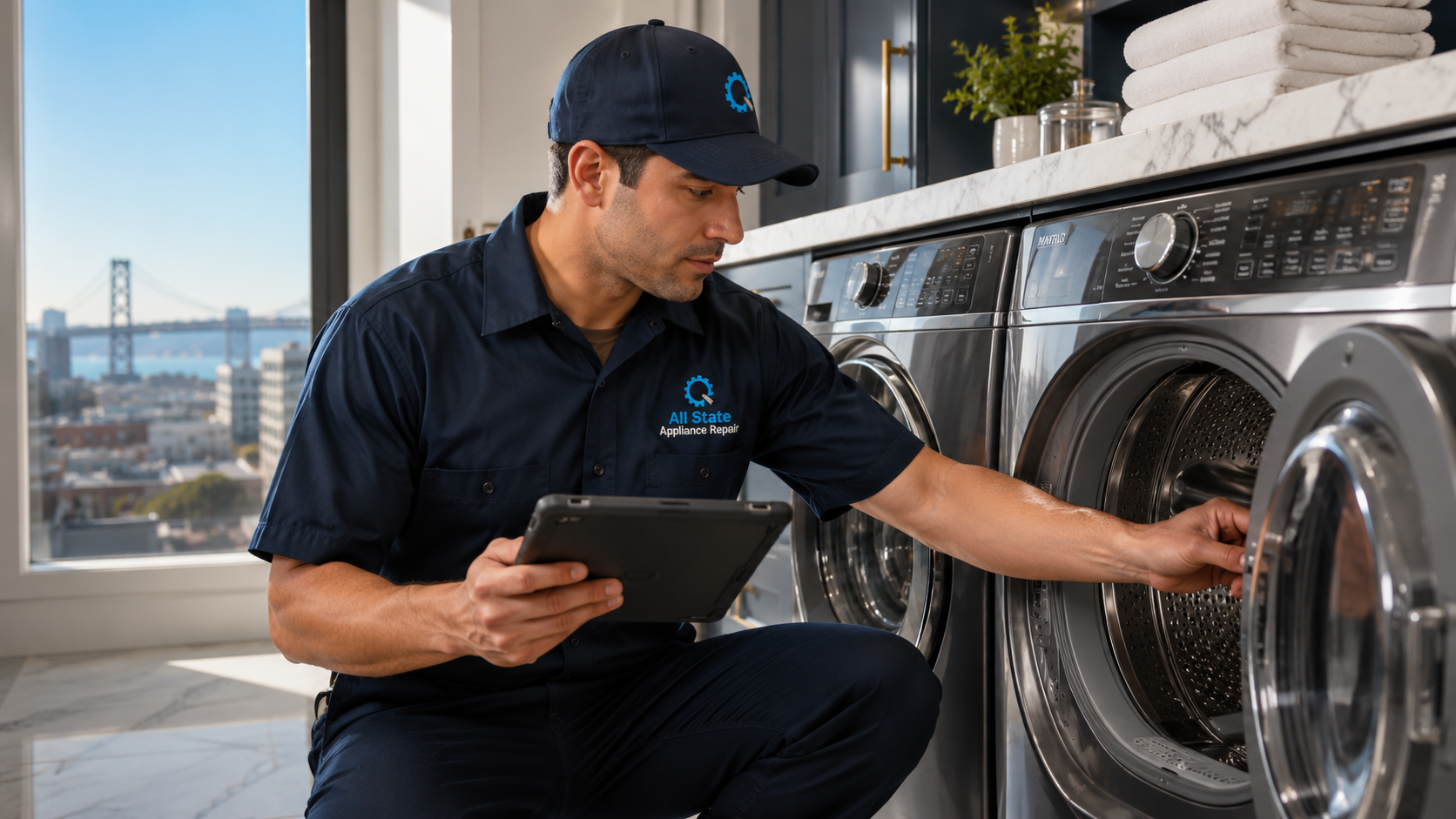



Top-load washers come in for drain pumps, lid locks, and transmission wear, while front-load washers usually need door interlocks, bellows seals, or bearing work. Stacked washers-dryers get full service too, including the tight-space disassembly a stacked tower needs before any part can be reached.
Electric dryers commonly fail at the heating element, thermal fuse, or cycling thermostat, and we carry those parts. Front-load electric dryers also need drum rollers, idler pulleys, and belts checked at every visit, plus a vent inspection, since restricted airflow is what destroys elements.
Front-load gas dryers bring a different fault list, with igniters, flame sensors, coil kits, and gas valves at the top of it. We test the burner cycle end to end, confirm safe ignition, inspect the vent run, and leave the appliance heating properly with every gas connection verified before we go.
Water sitting in the tub after a cycle usually points to a blocked drain pump, a clogged hose, or a coin or sock caught in the impeller. A failed pump motor or pressure switch does the same thing. We clear the obstruction, test the pump under load, and replace it when the impeller is gone.
A tub full of soaking clothes often means a worn drive belt, a failed lid lock switch, or a clutch and transmission that stopped engaging. Front-load units add door interlock faults. We confirm the switch signal, inspect the belt and drive assembly, then replace whatever is actually slipping.
Water on the floor usually traces back to a cracked hose, a loose clamp, a worn door bellows on front-load models, or a leaking tub seal. Too much detergent also forces suds past the gasket. We find the exact source with a controlled fill test, then reseal or replace the component that failed.
Grinding, banging, or a deep rumble during spin points to tub bearings, worn suspension, or a foreign object trapped between the tub and the basket. An unlevel cabinet amplifies all of it. We open the machine, check bearings and shock absorbers, and rebalance the unit once the repair is finished.
A drum that turns without heat is usually a blown thermal fuse, a failed heating element, or an open high-limit thermostat, and on gas models a weak igniter or coil kit. Blocked venting causes most of these failures. We test each part, replace what reads open, and clear the vent run.
Damp clothes after a full cycle almost always mean restricted airflow from a lint-packed vent, a kinked duct, or a crushed transition hose. A tired blower wheel or a drifting moisture sensor adds to it. We clear the run, measure airflow at the exit point, and verify the sensing circuit reads true.
No response at the start button usually points to a tripped breaker, a failed door switch, a broken start switch, or a start relay on the control board. A snapped belt can also cut the motor switch. We check incoming power first, then trace the start circuit and replace the failed contact.
These washer alerts group around door lock faults, drain trouble, fill and water supply problems, and excess suds. Each one narrows the search quickly, and we read the stored fault history on site before touching a single part.
Electric dryer codes flag door, temperature, heater, and airflow problems reported by the control board. We pull the code, confirm it against live readings at the component itself, then repair the cause instead of clearing the display.
Gas models report heating, thermistor, and door faults through the same display logic, with a normal standby state included in the set. We verify ignition and full burner behavior directly before calling any gas code resolved.